First-Party Data: The New Standard for Event Marketing (Here's Why)

Here’s an inconvenient truth to all the event marketers out there: reaching your audience costs more every year and tells you less about who you actually reached. Hurts, but it’s true.
Why is this the case? Well, four forces are pushing online marketing in the same direction:
- Platform consolidation. Meta, Google and Microsoft sit increasingly between event organizers and their own audience, which turns a direct relationship with your visitors into a rented one.
- Regulation. Data protection enforcement is tightening in the Netherlands, Belgium and Germany specifically, and cookie banners are now an active target rather than a box to tick.
- Technology. Browsers block or restrict third-party tracking by default, and the ones that don't yet are heading that way.
- Culture. Audiences are refusing at the consent banner more often than they used to.
This can and should be addressed with one clear solution: own the data yourself. In more marketing-speak: Collect first-party data.
Owning your own audience data, means that you have better control over your data, aren’t reliant on big tech platforms to drive your marketing, and are better able to address technological barriers.
Below, we’ll dive into why third-party tracking is losing reliability, what first-party data actually is, and how first-party data can be collected via server-side tracking.
What's happening to third-party cookies in 2026?
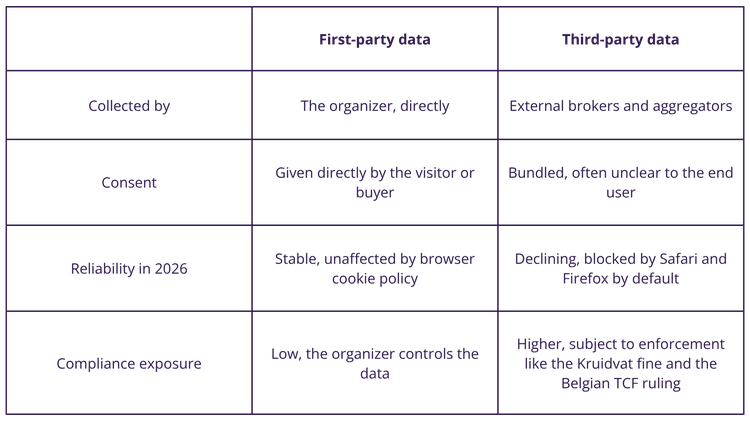
Third-party cookies, as many have proclaimed on the LinkedIn-osphere, are dying out. Safari and Firefox already block third-party cookies by default, so a meaningful share of your ticket shop traffic is cookieless.
For Dutch and Belgian event audiences that share skews higher than the global average, because iPhone penetration is high and a lot of ticket-buying happens on mobile.
This erosion isn't only about cookies, though. Consent banners vary wildly in how they're built, and each variation leaks data. Up to 60% of visitors decline consent when visiting websites. On top of that, ad blocker usage is increasing, now at approximately 30% usage rate, especially highest on desktop, and tracking prevention affects all browsers except Chrome, up to 40%. Technology is one of your single biggest speedbumps in gathering quality marketing data.
Regulators are moving in the same direction. What used to be a ‘Wild West’ of digital marketing has moved to a tightly-regulated market in the EU. With the Digital Services Act, and Digital Markets Act, plus GDPR policy and more, following regulations is proving to be a tricky balancing act for marketers.
Relying on third-party tools to collect your data for you simply is just not feasible for modern event marketers now. That’s where first-party data comes in.

What is first-party data?
First-party data is data you collect directly from your own audience, through your own channels, with their consent.
For an event organizer that means how a ticket-buyer behaves on your site, data that they knowingly, or unknowingly share, and how they shop for tickets in your ticket shop. This can include their preferences, browsing behaviour, genre interests, and more. You collected this data, you know how you collected it, and you can prove it. This is stored in your CRM, or in your server, so you can access it for your marketing campaigns without needing to use a third-party aggregator.
Good to note: Zero-party data is a close relative worth knowing about. Zero-party data is information a person hands over deliberately because they want something back. A ticket-buyer explicitly selecting their favorite genres, or filling out registration data in your ticket shop.
Event audiences do this more willingly than most industries do, because the payoff is obvious to them. A ska-punk fan wants to be told about a ska-punk show three cities away, and they'd rather you knew that.
What first-party data should event marketers collect?
Four categories carry most of the weight:
- Name, email and marketing consent, collected at ticket purchase or newsletter signup. In Stager this information lands in your Contacts.
- Purchase history: which events someone bought for, how many tickets, how far in advance. In Stager, Orders.
- Event and genre preferences, either auto-tagged from what someone buys or set by the contact in their own account. In Stager, Customer interests.
- Website and ticket shop browsing behavior: which pages someone looked at before buying, or before not buying.
The first three you almost certainly already have if you work with Stager. However, the fourth is a key data source that’s draining away, because it lives in the browser, which is exactly where the third-party data blocking happens.
It's also the category your paid campaigns depend on most, since ad platforms optimize on what they can see about visitor behavior.
The best way to combat this is through implementing server-side tracking.

How does server-side tracking work?
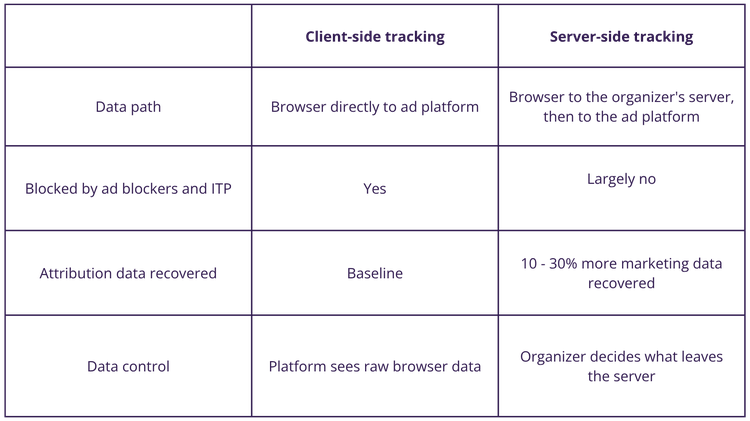
Server-side tracking routes visitor data through your own server first, and sends it on to ad platforms from there, instead of letting the browser report straight to Meta or Google.
That single change matters because browser-based tracking is intercepted constantly by ad blockers, tracking prevention and privacy settings. Your server isn't. When the data goes out from your own infrastructure, it arrives. This gives you, as an event marketer, control. You decide what leaves your server and what stays.
Client-side tracking - which collects third-party data - hands the ad platform whatever the browser sees and trusts it to behave.
Setting this up used to mean costly development time, and an expensive bill from a developer. It doesn't anymore. Stager partners with TAGGRS, a Dutch first-party performance platform that improves the quality of marketing data through server-side tracking. It acts as the central hub before data reaches analytics and advertising platforms, reducing data loss and strengthening measurement reliability. This helps businesses optimize campaigns and make better data-driven decisions, keeping your data path inside Europe and inside your control.
Key takeaways
- Third-party data isn't gone, but it's getting harder to access and harder to trust, and that direction of travel is set by browsers and regulators rather than by one platform's policy.
- Most organizers using Stager already own more first-party data than they realize. The gap is usually browser-based visitor behavior, not contact or purchase data.
- Server-side tracking closes that gap and keeps you in charge of what you share with ad platforms.
Frequently Asked Questions
Name, email address and marketing consent at minimum, collected at checkout or signup. Add purchase history and genre or event preferences to make the data useful for segmenting. In Stager these live in Contacts, Orders and Customer interests.
Yes. Returning visitors are the cheapest audience you have, because you already know what they bought and what they're likely to want next. A segmented mailing to people who bought a similar show consistently outperforms a general newsletter blast.
Yes, as long as the shop is yours and the buyer consented. Data a ticket buyer gives you while browsing, and during checkout in your own Stager shop is first-party data, and you own it.
It sends more complete conversion data back to platforms like Meta and Google. Better input means better optimization, more accurate attribution, and less budget spent on campaigns that look worse than they are.
Yes. Server-side tracking changes how data travels, not whether you need permission to collect it. Consent rules according to GDPR regulations apply to first-party data too, and a banner that nudges people into agreeing is exactly what regulators in the Netherlands and Belgium have been fining.
Author
Written by Tom Harden
Marketing and Communications Coordinator