Raise Your Event Page’s SEO and GEO Ranking Without Lifting a Finger
As an event marketer, you do a lot to make sure your event gets seen by people.
You design posters, run ads, perfect prose on press releases, send out stunning newsletters, and create content for your socials..
With all channels you need to juggle as an event marketer, there’s barely time to focus on a channel like SEO (Search Engine Optimization), and its little-but-fast-growing sibling GEO (Generative Engine Optimization).
After all, SEO takes a lot of time and effort, and asks you to invest in writing high-quality content. And GEO, well, where do you even start? You have enough on your plate as it is!
For event marketers, maybe SEO and GEO feels more in the realm of B2B software companies. But, as a B2B software company ourselves, we want to argue that SEO and GEO are not only extremely important for your event marketing, but also it can be easy and automated!
In this article, we’ll be joined by Matt Yau from our partner CultureSuite - an expert in building websites and digital marketing infrastructure for cultural organizations - to tackle the topic of SEO and GEO.
We will show why SEO and GEO matters for your events, and how you can build authority, relevance and recency through structured Schema markup to raise the SEO ranking for your event pages.
What is SEO and GEO (in Event Terms)?
If you haven't heard these terms yet, let’s get you up to speed.
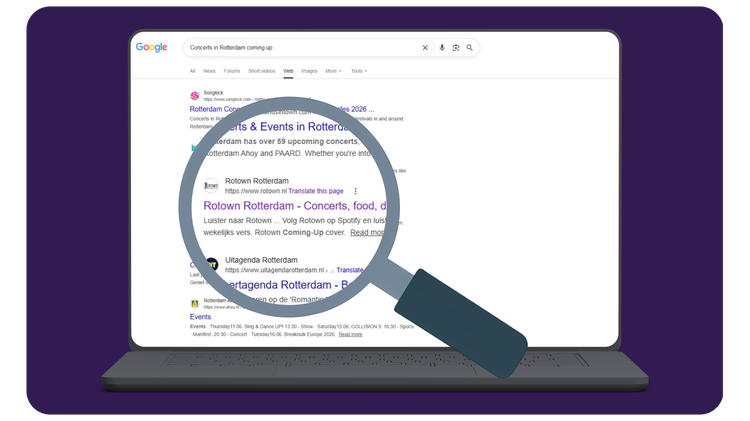
SEO: Search engine optimization. In event marketing terms: it measures how easy it is to find your event pages when people search for your event or related events. For example, if someone searches for ‘indie sleaze club night Amsterdam’, you’d want to make sure your ‘Indie Sleaze All Nighter’ event shows up high in the search results.
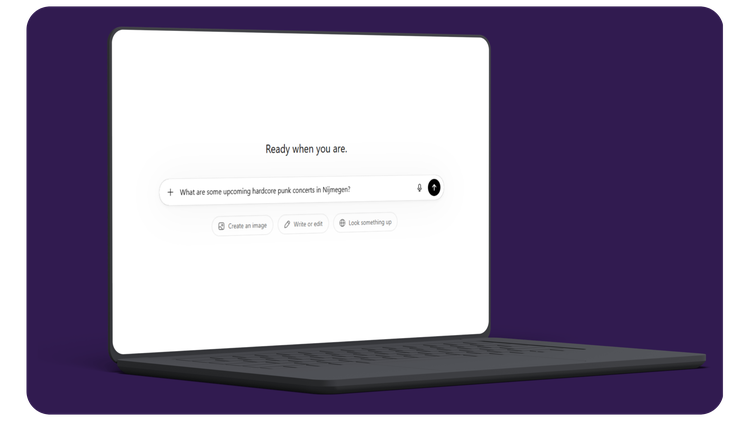
GEO: Generative engine optimization. For an event marketer, this means how often your events show up in generative AI responses when given a prompt related to your events. For example, if someone asks ChatGPT, Gemini, Perplexity or other GenAI engines what club nights are happening in Amsterdam this weekend, you’ll want it to recommend your event.
Does SEO and GEO matter for event marketing?
Absolutely. While you may have a great loyal audience of visitors who rely on your email marketing and social media content to know about your events, there’s also a vital segment of event-seekers who use search engines to discover local events.
We can see in Stager that 15% of all traffic coming to our shops are from search engines. This is the third most valuable source of traffic for our users, making up a large chunk of traffic.
How can you improve your event page’s SEO ranking?
Search engines and AI aim to show the most credible, relevant, and up-to-date information that matches the user's specific intent. Google's E-E-A-T framework (Experience, Expertise, Authoritativeness, and Trustworthiness) underpins how your event page is evaluated, and getting it right will make or break your SEO and GEO efforts as an event marketer.
Experience refers to demonstrated, first-hand knowledge of the subject. For event pages, this means showing that you're directly involved in the event itself, not just writing about it. Details like artist lineups and venue specifics all signal that your page comes from someone with real experience of the event.
Expertise is about how well your content meets the needs of someone searching for an event. If you're hosting a jazz event in Rotterdam, it's unlikely you'll show up in search results for crust-punk shows in Berlin. Targeted, specific content that speaks directly to your audience is what earns you relevance in the right searches.
Authoritativeness is the extent to which search engines and AI deem your website a credible source of information. Authority is built through reliable structured web data, and from other sites referring to your event page, for example, through event discovery platforms. This signals that you're the official ticket-seller and primary touchpoint for an event.
Trustworthiness encompasses all three of the above, but also hinges on recency. For live events, search engines and GenAI tools are heavily biased towards showing the most up-to-date information, prioritising content published within the last 30 days. Your event page is essentially a 'decaying asset' that must stay fresh with updated information, or it risks being left behind by AI and search engines.
For event marketers, the best way to ensure that you can optimize your authority, relevance and recency, is by providing structured, automatically-updated Schema markup for your event pages.

What event schema markup actually does for your events
Schema markup, specified in schema.org/Event, is the DNA of your event page. While we see an event page, with a nice artist biography, press picture and ‘Buy Tickets’ button, search engines and generative AI see schema markup - a piece of code (usually called JSON-LD) that structures your event page information in a way that is easy for search engines and generative AI to understand.
The main benefit of including Schema markup in your webpages is that it builds expertise, experience, authority, and trust around your events so that you gain relevance to people’s queries, and are seen as a point of authority for events. This means you’ll rank higher in search results, and appear more often in AI-generated answers.
In short: If AI can’t easily read when and where your event is happening, how could it recommend it to someone when they ask ‘What’s happening in my city this weekend’?
What does good event schema markup look like?
A good schema markup for your event needs to have a few essential fields:
- startDate & location — the basic, must-have information about your event. For location, make sure you include the full address with street, city, and postcode, not just the venue name. This ensures your location data is fully populated and machine-readable.
- offers — describes the price and currency for your event. This is crucial for those searching based on price (e.g. 'cheap concerts in Rotterdam'). Offers should also include an availability status (in stock or sold out) and a direct deeplink URL that takes the user straight into the purchase flow for that specific event.
- performer — links the artist's authority to your venue.
- eventStatus — allows you to mark your event as sold out, postponed, and more without losing SEO rank.
One often-overlooked detail: if a single page lists multiple dates or performances of the same event, each one should have its own schema block. This allows search engines to surface the right date with the right availability and price — including correctly flagging individual sold-out dates.
Below is a great example of solid schema markup for an event that will help search engines and Large Language Models read your event information.
How do I easily add event schema markup to my website?
You can add schema markup for your event pages manually, by adding the JSON script directly into the <head> section of your webpage’s HTML code, or through your website CMS, if that is available.
But for venues, clubs and festivals, this is a big-ask. Multiple events per week, each with changing event statuses, updated information and timings. That’s a lot to manage if you want to use schema markup well. After all, outdated information is seen as untrustworthy and will be ignored by LLMs and harm your SEO.
If you want to avoid manually inputting schema for every single event (as our title suggests, without lifting a finger), the best way is to let your event tooling do the heavy lifting.
Your event management system - like Stager - syncs directly with website platforms like CultureSuite. When you create the event to sell tickets, the website automatically builds the page and writes the JSON-LD Schema code in the background.
That way, your event information is then:
1. Easily readable by LLMs and search engine crawlers.
2. Always accurate and relevant.
3. Much more likely to be recommended by AI.
Futureproof your digital presence
Don’t fall behind with your GEO and SEO strategy. It doesn’t need to be difficult, and just by reading this article you’re taking the best first steps in informing yourself. What’s next then?
- Audit your current setup: Does your CMS support schema markup? If you use Culturesuite, then your schema is automatically generated when creating a new event page.
- Whether through custom scripts or integrations like Stager’s integration with CultureSuite, move toward a workflow where "publishing an event" and "optimizing an event" are the same action.
- Keep your schema updated. Freshness matters for events, as event pages are a decaying asset. If you have lineup changes, changes in ticket status (i.e sold out), new timings, ticket waves and more, you should make sure your event schema reflects these changes. Then your page is updated, and its information stays fresh, and relevant.
- Double-check for accuracy! Use tools like Google's free Rich Results Test or the Schema Markup Validator tool to ensure your schema is accurate and correct. This is the hardest friction to optimise for in your web flow. Instead, the most effective way to manage this is by utilising remarketing tactics.
Frequently Asked Questions
Schema markup translates your website's visual content into a standardized machine-readable language. For event organizers, this code explicitly identifies the event name, date, venue, and ticket link. Providing this clear data allows search engines and LLM's to understand your event, and recommend it to people when they search for events like yours.
Large Language Models (LLMs) and AI search engines do not browse websites the way humans do; they scrape data to synthesize direct answers for users. When someone asks an AI assistant, "What samba and jazz concerts are happening in my city this weekend?", the AI relies on structured data to pull accurate answers. If your event page lacks proper Schema markup, AI models cannot verify your event's details, making your venue virtually invisible to conversational AI queries.
To qualify for Google's rich search results, your JSON-LD code must include at least five core pillars: the event name (name), a valid start date (startDate), a physical or virtual venue (location), an event image (image), and ticketing information (offers) containing the price and currency. Leaving out any of these required fields will cause Google’s validator to flag your page, preventing your event from appearing in LLM responses.
If you update your page text but fail to update your Schema code, search engines see a data mismatch, which can damage your authority. Using the eventStatus field (such as EventPostponed or EventCancelled) and the availability field (such as OutOfStock) communicates real-time changes directly to search engines. This preserves your SEO rankings while keeping fans informed right from the search results page.
Yes, and for busy venues, automation is the industry standard. Manually coding JSON-LD for dozens of monthly events leaves too much room for human error. By linking your ticketing and event management software (like Stager) directly to a culturally optimized CMS (like CultureSuite), your website automatically builds the required Schema markup the moment an event is created in your box office dashboard. This eliminates manual data entry entirely while guaranteeing error-free SEO and GEO performance for your event pages.
Author
Written by Tom Harden
Marketing and Communications Coordinator